Quick answer: Duolicious is a genuinely 100% free, open-source dating app — no paywall, no swipe limits, free unlimited messaging — born on 4chan and built for the “chronically online.” It’s legit and it’s not a scam. The catches are real, though: a heavily male-skewed user pool (the founder has cited ratios from about 7:1 up to 20:1), light verification, and a culture that’s either your exact people or absolutely not. Here’s the full honest rundown.
What Is Duolicious?
Duolicious calls itself the internet’s most popular open-source dating app, and both halves of that sentence are doing real work. It launched publicly in July 2023 — with an anonymous post on 4chan’s /soc/ board, of all places — hit Android app stores in March 2024, and went properly viral that May, briefly out-ranking eHarmony on Google Play’s free dating chart. As of this writing it runs on the web (web.duolicious.app), iOS, and Android, and it’s alive and actively maintained.
Two things make it genuinely unusual:
- It’s free. Actually free. Not free-with-a-catch, not free-until-you-want-to-message-someone. Matching, browsing, and unlimited messaging cost nothing.
- It’s open source. The entire codebase — app, backend, chat server — is public on GitHub under the AGPL license. Anyone can audit the code or even self-host their own copy. No other dating app of note lets you do that.
The maintainer, notably, is anonymous — the project is run through a GitHub organization rather than a named founder. That’s on-brand for where it came from, and worth knowing before you decide how much to trust it with.
How Duolicious Works (No Swiping, Really)
Duolicious skips the swipe deck entirely. Instead, it leans on a personality quiz that is — and we can’t stress this enough — enormous: a bank of roughly 2,005 questions measuring 47 traits, covering Big Five and MBTI-style dimensions and even political leaning. You answer as many as you like; the more you answer, the sharper your compatibility scores get. Add “clubs” (shared-interest tags) and you get matched on who you actually are, not just your best photo.
Then comes the part that surprises people: you can message anyone, free, without matching first. No mutual-like gate, no “see who liked you” paywall.
To keep that from becoming a spam firehose, Duolicious has one clever gimmick: your opening message has to be original. The app literally blocks first messages that someone else has already used — every “hey,” “hi,” and “sup” was claimed long ago. You’ll have to write a real sentence. Honestly? More apps should steal this.
Signing up needs an 18+ age confirmation, and verification is optional and face-optional: an AI check on an uploaded photo, or a manual verification selfie. Your profile never has to show your face — common in this community — but remember that cuts both ways when you’re deciding whether the cute anime avatar you’re talking to is real.
What Duolicious Costs (and the “Will It Shut Down?” Question)
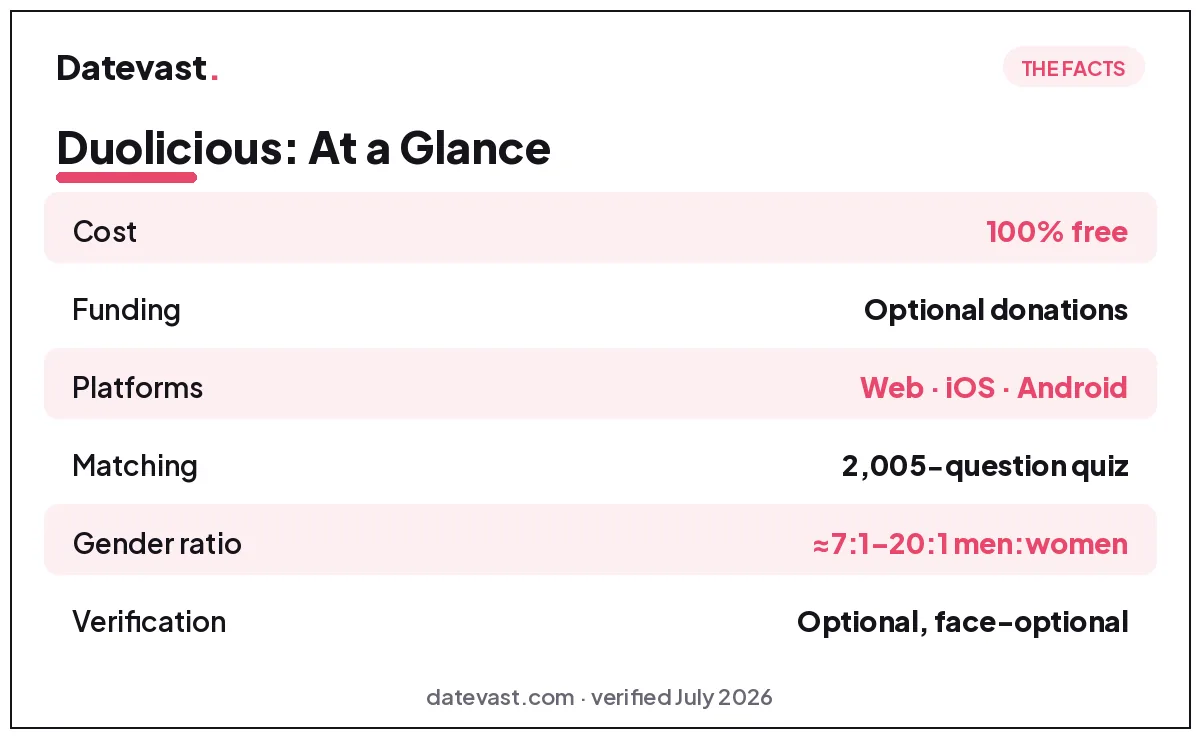
Everything that matters is free. There’s no premium tier that unlocks messaging, no boosts you’re nudged to buy, and no ads that we encountered. The project runs on optional donations (via Ko-fi) and an optional supporter membership with member-only perks; the maintainer’s pitch is that it costs “less than 1% of what Tinder charges” to keep the servers on.
That leads to the question fans keep asking: is it about to shut down? The honest answer: the app has always run hand-to-mouth. In late 2024 the maintainer publicly noted the servers stayed up because one donor kept covering the monthly bill. But the doom never arrived — the app kept growing (it announced its 300,000th cumulative sign-up in August 2025) and it’s still running as of July 2026. Donation-funded means fragile, and fragile means the shutdown risk is never zero. It also means the app has no incentive to keep you single and swiping — which, after a decade of engagement-optimized dating apps, feels almost radical.
The Gender Ratio: Read This Before You Download
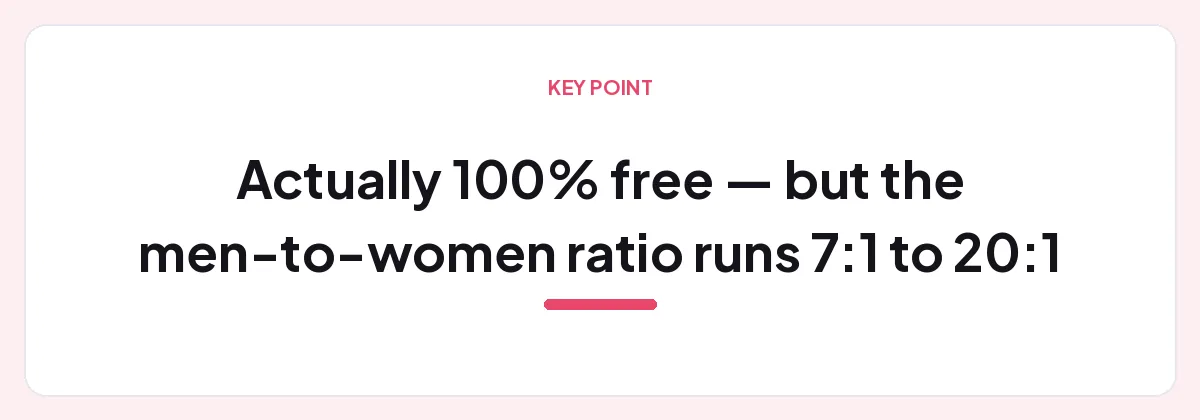
Here’s the number that decides whether Duolicious is worth your evening. The user base is heavily, heavily male. The founder’s own figure in early 2025 was about 7.3 men per active woman, and he noted it swings with whichever corner of the internet is talking about the app — it has been as lopsided as 20:1.
What that means in practice:
- If you’re a man: expect a quiet inbox and a small pool. The free unlimited messaging helps, but you’re competing with everyone else who read the same sentence. Write genuinely original openers (the app forces the first one anyway) and fill out the quiz — compatibility is your differentiator here, not photos.
- If you’re a woman: you will be swamped with messages. The originality filter blunts the lowest-effort stuff, and face-optional profiles give you unusual privacy control — but moderate your expectations about signal-to-noise.
No dating app publishes honest ratio numbers; credit to this one’s founder for stating his openly. But it’s the app’s biggest structural weakness, and no feature fixes math.
Is Duolicious safe — and are the profiles real?
Duolicious is legit — a real, functioning, actively maintained app, not a scam or a fake-profile chat mill. Scam-checkers rate the domain fine-to-middling, and crucially there’s no financial incentive for fake profiles: nobody profits when you send a message, because messages are free.
That said, the safety picture has real caveats:
- Catfish and troll accounts exist. Verification is optional and face-optional, so the barrier to a fake or joke profile is low. Reviews regularly mention catfishing, “chaos” profiles, and ghosting. Treat any account that won’t voice-chat or video-verify as unconfirmed.
- Moderation is human but reactive. A small team works from user reports, with a warnings→removal→ban ladder. Public nudity and solicitation are banned. But this is a shoestring project, not a trust-and-safety department — report and block liberally, and don’t expect instant enforcement.
- A real privacy lesson from 2024: during the app’s viral spike, profile data visible to logged-in users was scraped and republished on a searchable third-party site. That’s a risk on every small platform (and plenty of big ones), but it’s concrete here: put nothing in your profile you couldn’t tolerate being public. The open-source code being auditable is a genuine privacy plus; it doesn’t stop another user from copying what you show them.
- The culture is unfiltered. This is a 4chan-born community that describes itself, fondly, as “brain rot.” Expect edgy humor and meme-dense profiles. The app bans the worst of it; the vibe remains distinctly imageboard. If that sentence made you wince, this isn’t your app.
Standard safety rules apply double on a face-optional app: video-chat before meeting, meet in public first, never send money or identifiable explicit content, and keep early conversations inside the app.
What Duolicious Genuinely Gets Right
Plenty, honestly — which is why people root for it:
- The pricing is the fairest in the industry. Free messaging with no gates, funded by tips. After reviewing apps that charge $40/month to see who liked you, this is a palate cleanser.
- Open source is a real trust feature. You don’t have to take the app’s word for what it does with your data — anyone can read the code. That’s unique in dating.
- Personality-first matching with actual depth. Two thousand questions is absurd in the best way. For people exhausted by looks-only swiping, the whole design points the other direction.
- It found its niche and serves it well. If your social life already lives on Discord, Reddit, or imageboards, the people here are recognizably yours — and profiles are genuinely fun to read.
- The original-opener rule kills copy-paste spam at the door.
So, is Duolicious worth it?
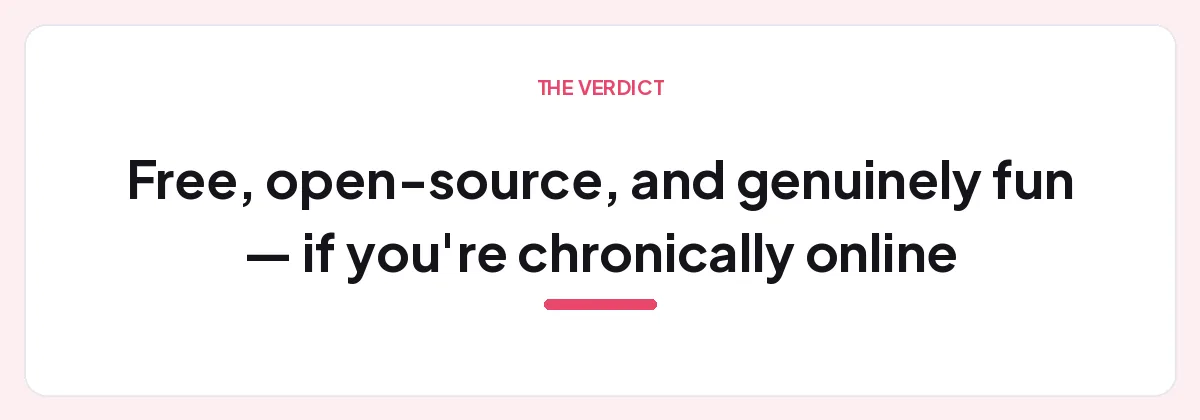
Yes for the right person, and it costs nothing to find out. That’s the whole verdict, really: the app is free, so the only thing you risk is an evening.
Try it if: you’re chronically-online by your own affectionate admission; you want personality-quiz matching without a paywall; you value open-source software; or you’re just curious what a dating app with no profit motive feels like.
Skip it if: you want a large mainstream dating pool, you need strong verification and active moderation, edgy internet culture puts you off — or (for men especially) a 7-to-20:1 ratio sounds like a worse evening than staying home. For a bigger, more balanced pool, our Hinge review and Bumble review cover the mainstream options honestly.
FAQ: Duolicious
Is Duolicious really free?
Yes — matching, browsing, and unlimited messaging are all free, with no premium tier required for anything that matters. The project runs on optional Ko-fi donations and a supporter membership with minor perks. There were no ads when we checked.
Is Duolicious safe and legit, or a scam?
It’s legit — a real open-source app with no pay-per-message model, so there’s no scam economics. Safety caveats: optional face-optional verification means catfish accounts exist, moderation is small-team and report-driven, and profile info was scraped by a third party during its 2024 viral spike. Share sparingly and verify people by video before meeting.
What is the Duolicious gender ratio?
Heavily male, and it swings. The founder’s own figure in early 2025 was about 7.3 active men per woman, with historical spikes to roughly 20:1 depending on which communities were talking about the app. Whatever the exact number today, plan around a male-majority pool.
Is Duolicious really a 4chan dating app?
That’s genuinely where it launched — an anonymous post on 4chan’s /soc/ board in July 2023 — and the culture still reflects imageboard/Discord/Reddit internet humor. It’s not affiliated with 4chan; it just grew up there.
How does matching work if there’s no swiping?
You answer questions from a ~2,005-question personality bank (Big Five and MBTI-style traits, 47 dimensions) and join interest “clubs”; the app scores compatibility from that. Then you simply message whoever you like — free — with one rule: your opening line must be original. Reused openers are blocked.
Will Duolicious shut down?
It’s donation-funded and has always run month-to-month — the maintainer has been open about servers surviving on donor generosity. But it has never actually gone down, kept growing past 300,000 sign-ups, and remains live as of July 2026. Fragile, yes; dying, no.
Also see: our reviews of Hinge, Bumble, and Plenty of Fish — or the full dating app directory.