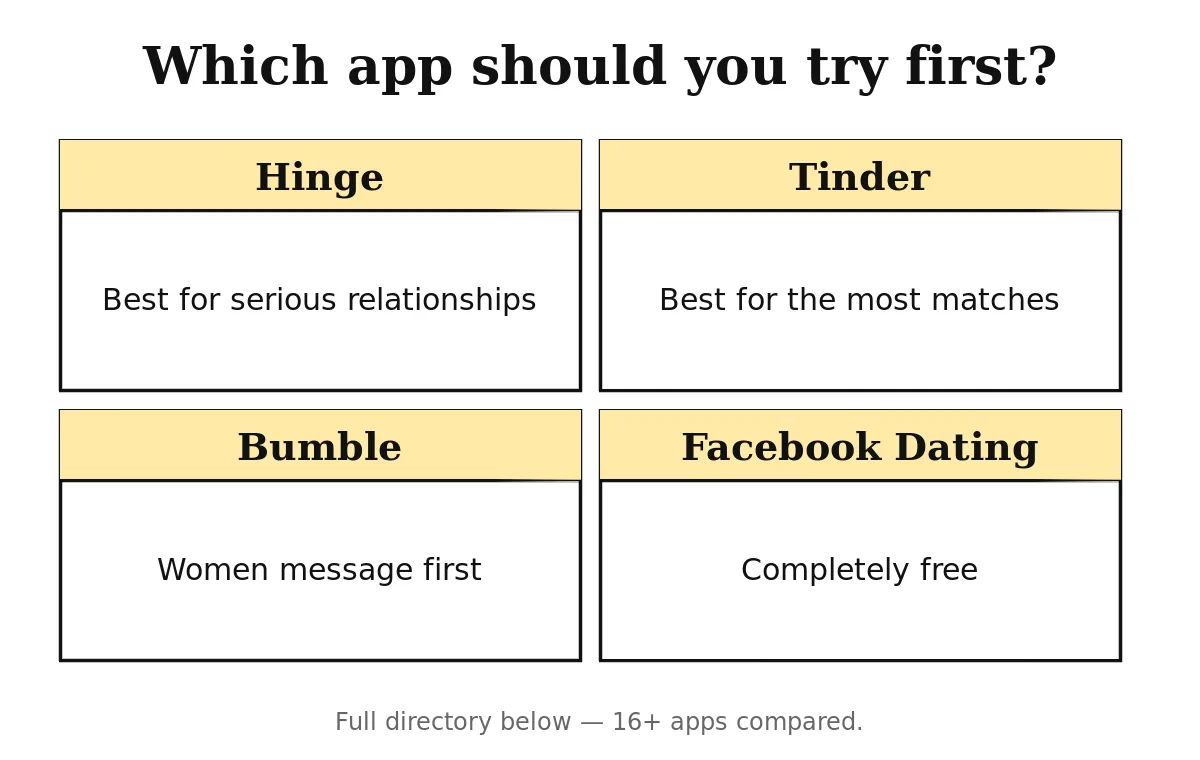
This directory compares the dating apps most people actually use, so you can pick one without downloading five and deleting four. Each listing covers who the app is built for, what it costs, and the one feature that sets it apart. If you want the short version: choose Hinge for a serious relationship, Tinder for the largest pool of matches, Bumble if you want women to message first, and Facebook Dating if you’d rather not install anything new.
Last reviewed June 2026. Prices are listed as ranges because every major app now uses dynamic pricing — what you pay can change based on your age, location, and how often you open the app, so always confirm the current price in the app store before subscribing.
Dating apps at a glance
| App | Best for | Cost | Platforms |
|---|---|---|---|
| Tinder | The biggest match pool | Free + tiers ~$10–40/mo | iOS, Android, web |
| Bumble | Women-first messaging | Free + tiers ~$15–40/mo | iOS, Android, web |
| Hinge | Serious relationships | Free + tiers ~$20–50/mo | iOS, Android |
| Match | All ages, proven track record | Paid (limited free) | iOS, Android, web |
| eharmony | Marriage-minded daters | Paid ~$36–66/mo | iOS, Android, web |
| OkCupid | Inclusive, question-based matching | Free + optional paid | iOS, Android, web |
| Coffee Meets Bagel | A few quality matches a day | Free + paid ~$35/mo | iOS, Android |
| Facebook Dating | No extra app, already on Facebook | Free | Facebook app |
| Plenty of Fish | Generous free messaging | Free + optional paid | iOS, Android, web |
| Grindr | Gay, bi & queer men | Free + paid upgrades | iOS, Android, web |
| HER | Queer women & nonbinary people | Free + optional paid | iOS, Android |
| Feeld | Open-minded & non-monogamous dating | Free + paid membership | iOS, Android, web |
Swipe-based and mainstream apps
Tinder
Tinder invented the swipe and still has the largest audience of any dating app, with roughly 75 million people opening it each month. That scale is its biggest draw: in most cities you will never run out of profiles. The free version covers a lot of swiping, while Tinder+, Gold, and Platinum add perks like seeing who already liked you, unlimited likes, and message-before-matching. Best for: anyone who wants the widest possible pool and is comfortable sorting through it.
Bumble
On Bumble, women make the first move: after a match, the woman has 24 hours to send the opening message (in same-sex matches, either person can start). That single rule cuts down on low-effort openers and unwanted attention. Bumble also bundles in friend-finding (BFF) and networking (Bizz) modes under one login. Best for: women who want more control over who contacts them, and anyone tired of empty “hey” messages.
Hinge
Hinge markets itself as the app “designed to be deleted.” Instead of swiping on photos, you like or comment on specific prompts and pictures, which gives every match a built-in conversation starter. Around 9 in 10 Hinge users say they are looking for a serious relationship, and the app consistently ranks highest for turning matches into real dates. The free tier limits you to a handful of likes a day; Hinge+ and HingeX expand that. Best for: people who want a relationship, not a time-killer.
Best apps for serious relationships
Match
One of the original dating sites, Match has decades of experience and a user base that skews a little older than the swipe apps. It offers several ways to find people — search filters, daily suggestions, and in-person events — which makes it flexible for different dating styles. The free tier is thin, so you are effectively paying to participate. Best for: daters over 30 who want a mature, established platform and don’t mind a subscription.
eharmony
eharmony leans hard into compatibility. You answer a lengthy questionnaire up front, and the app matches you on personality and values rather than looks alone. It attracts people who are explicitly marriage-minded, and its messaging tools are built to encourage real conversation. Like Match, it is a paid service with a very limited free tier. Best for: people who want a structured, long-term-focused approach and are willing to invest in it.
OkCupid
OkCupid matches you using answers to thousands of optional questions, covering everything from politics to lifestyle. It is one of the most inclusive apps, with extensive gender and orientation options, and its free tier is genuinely usable. Best for: people who want matching based on values and don’t want to pay to get started.
Coffee Meets Bagel
Coffee Meets Bagel deliberately limits how many matches you see each day, nudging you toward quality over endless swiping. The curated approach appeals to busy people who want a few thoughtful options rather than an inbox to manage. Best for: daters who want intention without a full-time swiping habit.
Free and low-cost options
Facebook Dating
Facebook Dating is completely free and lives inside the Facebook app you probably already have — there is nothing extra to download and no separate subscription. Your dating profile stays separate from your main profile, it never matches you with existing friends (unless you both opt into Secret Crush), and it can suggest people through shared groups and events. Because it is hidden inside a menu, the hardest part is often just finding it. We cover the details in our guides on where to find Facebook Dating, turning on the Dating icon, matching and chatting with singles, and using Facebook Dating groups. Best for: anyone who wants a free option without installing a new app.
Plenty of Fish (POF)
One of the oldest and largest dating sites, Plenty of Fish is known for letting you message freely without paying, which is rare among the big names. The interface feels dated next to newer apps, but the generous free features keep it popular, especially outside major cities. Best for: people who want to message matches without hitting a paywall.
LGBTQ+ and identity-focused apps
Grindr
Grindr is the largest app for gay, bi, trans, and queer men, used by more than 27 million people across nearly 200 countries. It is grid-based and location-first, showing you nearby profiles immediately, and basic chat is free with paid Xtra and Unlimited tiers removing ads and adding filters. Best for: queer men who want a large, location-based community.
HER
HER is built specifically for queer women, nonbinary, and trans people, combining dating with a community feed of local events and groups. It is free to use with optional premium features, and its women-and-nonbinary-only space is a big part of its appeal. Best for: sapphic and nonbinary daters who want a community as well as matches.
Feeld
Feeld serves open-minded daters, including couples and people exploring non-monogamy. It offers a wide range of gender and sexuality options and lets partners link accounts, making it the most established app for ethical non-monogamy. Best for: people and couples seeking open, judgment-free dating.
Exclusive and curated apps
A few apps gate access on purpose. Raya is application-only and popular with creatives and public figures, prioritizing privacy and a screened member base. The League markets itself to career-driven, education-focused daters and uses waitlists and curated daily matches. Both trade a large pool for a more filtered one — useful if exclusivity matters to you, frustrating if you just want options. Best for: daters who value a vetted, smaller community over reach.
If your priorities are more specific than any single app — faith, single parenthood, or a hands-on matchmaker — see our roundups of the best dating websites for single parents and the top matchmaker websites.
How to choose the right dating app
- Decide what you want first. For a long-term relationship, start with Hinge, Match, or eharmony. For casual dating or sheer volume, Tinder and Bumble win.
- Match the app to your community. Queer daters are often better served by Grindr, HER, or Feeld than by the mainstream apps’ add-on filters.
- Try the free tier before paying. On Tinder, Bumble, Hinge, OkCupid, and Facebook Dating, the free version is usually enough to judge whether the people there are a fit.
- Be skeptical of subscription prompts. Because pricing is dynamic, the “discount” you see may not be the best available — compare a few plan lengths before committing.
- Use two apps, not five. Spreading yourself across many apps usually means thin profiles and missed messages. Pick one mainstream and one that fits your goal.
Staying safe on dating apps
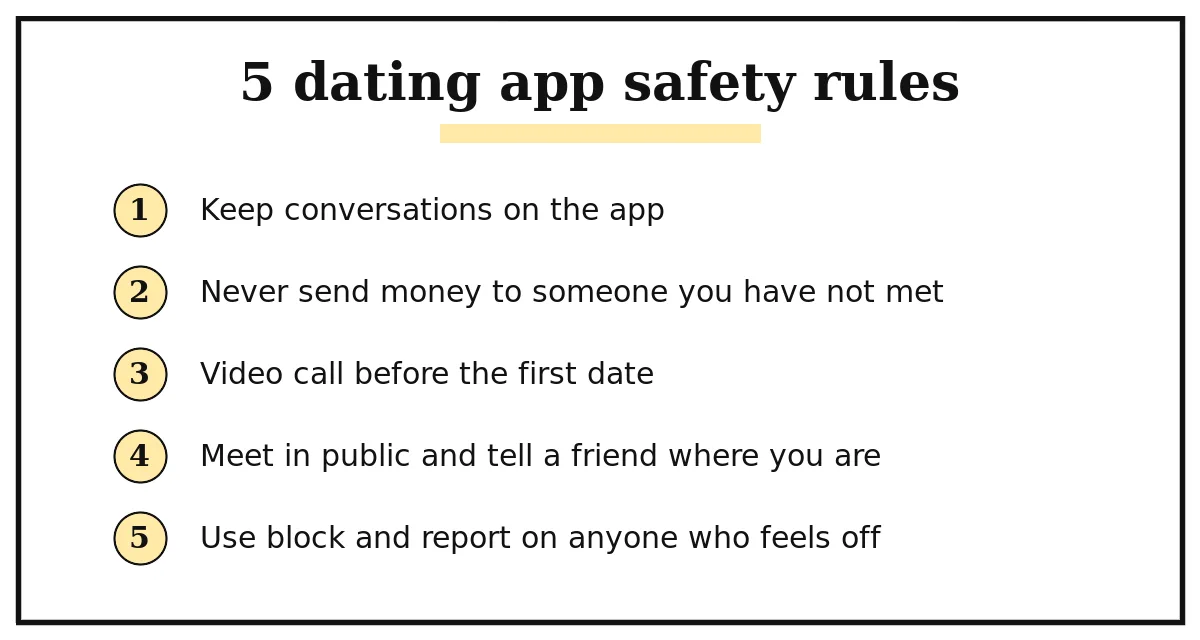
- Keep conversations on the app until you trust someone; scammers push to move to text or WhatsApp quickly.
- Never send money to someone you have not met in person, no matter the story.
- Video chat before a first date to confirm the person matches their photos.
- Meet in a public place, tell a friend where you are going, and arrange your own transport.
- Use the in-app block and report tools — they help protect other users too.
Frequently asked questions
Which dating app is best for serious relationships?
Hinge, eharmony, and Match are the strongest choices for long-term dating. Hinge is built around relationship intent and converts matches into dates well, while eharmony and Match use detailed profiles and compatibility tools that suit people specifically looking to settle down.
Are dating apps free?
Most have a free tier. Tinder, Bumble, Hinge, OkCupid, Plenty of Fish, Grindr, and HER all let you create a profile and match for free, and Facebook Dating is entirely free. Match and eharmony are the main exceptions — their free tiers are too limited to use seriously.
Is Facebook Dating any good compared to paid apps?
For a free service it is surprisingly capable: it taps into your existing Facebook network, keeps your dating activity private from friends, and matches through shared interests, groups, and events. It lacks some of the polish and advanced filters of paid apps, but for many people the price — nothing — makes it the obvious place to start.
Which dating app is safest?
Safety depends more on your habits than the app, but Bumble’s women-first messaging and the photo-verification badges offered by Tinder, Bumble, and Hinge all reduce fake profiles. Whichever app you use, keep chats on-platform, video call before meeting, and meet in public.
How many dating apps should I use at once?
One or two is plenty. A single mainstream app plus one that fits your specific goal gives you reach without spreading your attention so thin that profiles go stale and messages get missed.
Found an app missing or a detail that needs updating? Tell us through our contact page — this directory is reviewed regularly.
Heads-up on one to avoid: read our CitySweeties.com review before you spend a cent — it runs on pay-per-message credits, not matches.