Short answer — be careful: CitySweeties.com is widely reported as a scam. Reviewers and scam-checkers describe it as full of fake profiles and paid “chat operators” who send flirty messages to bait you into buying credits to reply, with real dates almost impossible to arrange, and its trust scores are very low. We’d skip it for a reputable dating app. Here’s the full breakdown of how it works, the red flags, and safer alternatives.

What CitySweeties Actually Is
On the surface, CitySweeties.com looks like a flirty local dating site. The landing page promises you can “flirt with fun locals around you” and claims “4 million members waiting” — a marketing number we found no independent audit for, so take it as exactly that: marketing.
Underneath, the picture changes fast. CitySweeties is operated by Meteor Interactive B.V., a Dutch company that runs a whole family of flirty “chat” sites on the same model — including Provocative Neighbors, its sister site we’ve also reviewed. And that model is the single most important thing to understand before you type in your email address:
CitySweeties doesn’t sell dating. It sells conversation — by the message, with people who are paid to keep you talking.
We checked the site live this week: it’s fully operational, registration works, and the sign-up flow is as smooth as any big-name app. That polish is part of why people get caught out. A scammy-looking site warns you off by itself; a clean, modern one doesn’t.
The Business Model: “Entertainment,” Not Dating
Here’s the part most people never read. According to reviewers who have gone through CitySweeties’ own terms and conditions, the site discloses — in the fine print — that it’s a “fantasy entertainment service” and that profiles on the platform can be fictional, run by operators. DatingSpot24’s review counted the fictional-profile disclosure directly in the site’s terms, and users report the platform is heavily populated by these “entertainer” accounts.
It gets more concrete. Meteor Interactive — the company behind CitySweeties — was the subject of a BBC investigation into how these chat sites really run. To be precise: the BBC’s reporting named a sister site on the same network, not CitySweeties itself — but it’s the same operator, and the company’s own response to the BBC is telling. Meteor said its terms and conditions make clear that some profiles are fictional and that meet-ups are “not possible.”
Read that again: the operator itself says meeting anyone from these chats isn’t possible. That’s not us being cynical — that’s their own statement.
The investigation also described how the chat side works behind the curtain: paid operators juggling dozens of fake “attractive local” personas, using location tools so the profile appears to be within about 50 km of you, and trained to write long, open-ended messages (150+ characters) that keep the conversation going — because every reply you send burns another paid credit. When you ask to meet, the answer is always a deflection: next week, maybe soon, let’s chat a little more first.
Once you know that, everything about the CitySweeties experience makes sense: the instant flirty messages the moment you sign up, the enthusiastic strangers who never video-call, and the dates that are forever almost-but-never happening.
What CitySweeties Costs
Joining and browsing are genuinely free — that part is real. The paywall lands exactly where the operators want it: on the reply button.
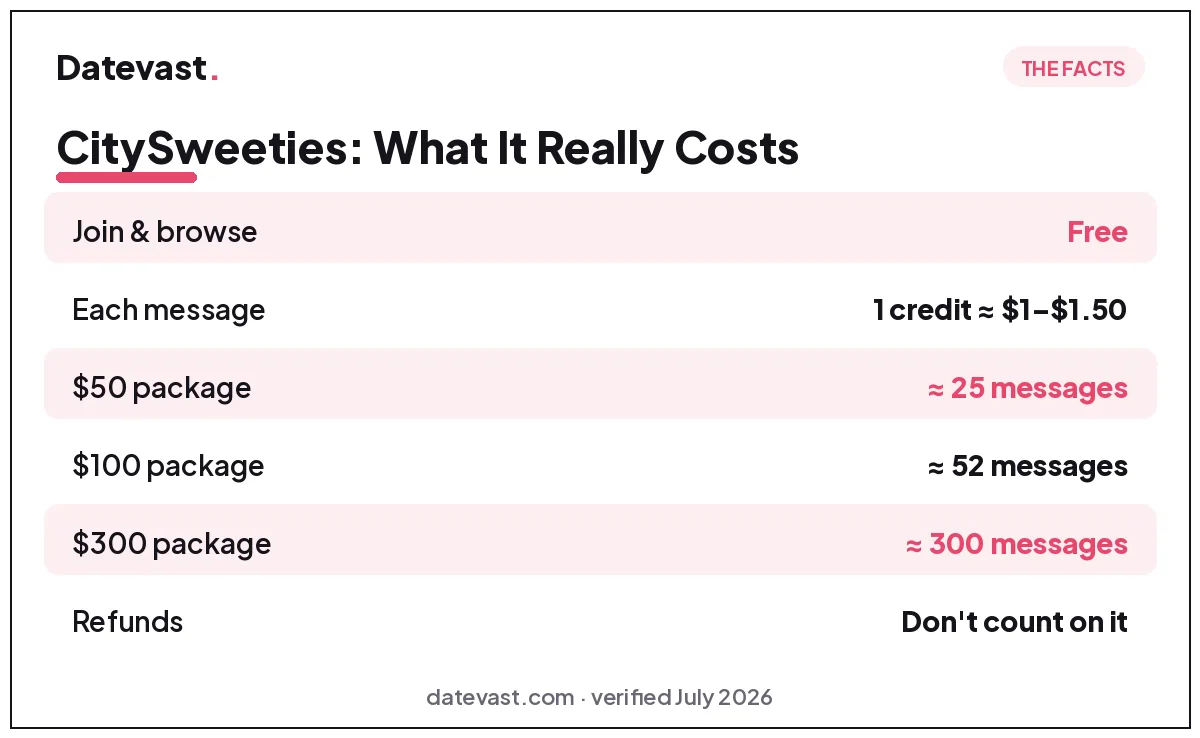
Messages cost credits, and reviewers put the effective price at roughly $1–$1.50 per message depending on the bundle — packages like $50 for 25 messages, $100 for 52, or $300 for 300 have been reported, and the BBC noted packages ranging from $6 to $300 across the operator’s network. Exact numbers can shift, but the shape never does: you pay per reply, and the person on the other end is incentivized to make you reply as many times as possible.
Two small mercies worth knowing:
- No subscription trap. Credits are a one-time purchase, not an auto-renewing membership — you won’t find a surprise recurring charge. The damage is done credit by credit, with your enthusiastic help.
- No refunds in practice. Credits are pre-paid virtual goods. If you feel scammed, your realistic options are a chargeback through your card issuer and a report to the FTC (or your country’s consumer authority) — not CitySweeties customer service.
One user complaint we found reported over $3,200 spent without a single real meeting. Treat that figure as an anecdote, not a statistic — but it shows how fast dollar-a-message adds up when the other side is paid to never say goodbye.
Signing Up: What Actually Happens
We walked through the current sign-up flow so you don’t have to. It asks for your gender and who you want to meet, your location, an email and username, and an 18+ age confirmation. That’s it.
Notice what it doesn’t ask for: any proof that you — or anyone else on the site — is a real, verified person. There’s no ID check, no photo verification, no linked social account. The “age check” is a self-declared gate.
And then comes the tell. Within minutes of creating a fresh, empty profile — no photo, no bio — new members typically report a wave of flirty messages from attractive locals. Ask yourself the question the operators hope you won’t: why would anyone message a blank profile? On a real dating app, a profile with no photo gets ignored. On a pay-per-reply chat site, a blank profile with a payment method is the entire target audience.
Are the Profiles Real? The Evidence
Let’s stack it up in one place:
- The site’s own terms reportedly disclose fictional “entertainment” profiles run by operators (per DatingSpot24).
- The operator’s own statement to the BBC: some profiles are fictional and meet-ups are not possible.
- ScamAdviser gives citysweeties.com a very low trust score and flags it for potentially sending high volumes of spam email and SMS.
- Scam Detector rates it scam-leaning.
- No Trustpilot page exists for the site at all, and the scattered user reviews we could find are uniformly negative: money spent, zero real dates, operator replies that dodge direct questions or read like they’re answering someone else’s message (because they probably are — each operator juggles dozens of chats).
One honest caveat: a couple of automated “site safety” checkers (like ScamFoo) label CitySweeties “potentially safe.” Read what those tools actually measure before you relax: SSL certificates, domain age, malware blocklists. CitySweeties passes those because it’s a professionally run website. A technically clean website can still be a financially hazardous one. Those scanners check whether the site will infect your laptop, not whether the woman messaging you exists.
Anything Genuinely Good About It?
Being fair matters — so here’s the honest positive column. Browsing is free, so you can look around without spending a cent. The interface is clean and works fine on phones. The connection is properly encrypted. And — credit where due — the company does disclose the fictional-profile model in its terms, which legally frames CitySweeties as adult entertainment rather than a dating service.
That last point cuts both ways, though. The disclosure is real, but it lives in fine print under a homepage that says “flirt with fun locals around you.” If the site led with “pay per message to chat with fictional personas,” nobody would confuse it for dating — and far fewer people would buy credits.
Who Might Still Use It (and Who Absolutely Shouldn’t)
If you fully understand that you’re paying roughly a dollar a message to exchange flirty texts with a paid entertainer you will never meet — and that’s genuinely what you want — CitySweeties technically delivers that product. Some people do treat these sites as interactive fiction, the way you’d pay for any other entertainment.
For everyone else — anyone hoping for a date, a relationship, a real human who might actually show up for coffee — this is simply the wrong place, by the operator’s own admission. You’re not bad at online dating; the game here is unwinnable by design.
Already Spent Money? Do This Now
If you’re reading this after buying credits, don’t beat yourself up — these sites are engineered by professionals to feel real. Here’s the damage-control checklist, in order:
- Stop buying credits immediately. Any “she’s finally ready to meet, just reply once more” message is the mechanism, not a breakthrough.
- Screenshot everything — your purchase receipts, the chats, the profiles. You’ll want evidence for the next two steps.
- Call your card issuer and dispute the charges (chargeback). Say the service misrepresented itself; mention the terms disclose fictional profiles. Banks have seen this pattern before.
- Report it — FTC at reportfraud.ftc.gov (US), Action Fraud (UK), or your country’s consumer authority. Reports are what eventually get payment processors to drop these operators.
- Delete your account and unsubscribe from every mailing option. ScamAdviser flags this domain for potential spam volume — you don’t want the follow-up “win-back” emails.
- If you shared personal details (phone, workplace, photos), assume they’re retained. Don’t send these sites anything you wouldn’t put on a billboard.
How to Spot This Model Anywhere (Not Just CitySweeties)
CitySweeties is one brand on one network — but this exact business model runs under hundreds of names, and new ones launch constantly. Rather than memorizing site names, learn the fingerprint. Any flirty “local chat” site is running the operator playbook if you see:
- Pay-per-message credits instead of a flat subscription. Real dating apps charge for features; chat-operator sites charge for replies, because replies are the product.
- Instant attention on an empty profile. Three flirty messages in your first ten minutes, before you’ve added a photo? Real people don’t do that. Paid ones do.
- An “entertainment” or “fantasy” clause in the terms. Search the T&C page for the words fictional, fantasy, entertainment, or operator before paying for anything. Thirty seconds of reading beats $300 of credits.
- Meet-ups that never quite happen. Enthusiastic chat, endless excuses, no video calls, no phone numbers. Operators are trained to keep it on-platform, where replies cost you money.
- Profiles that look like stock photography and messages that don’t quite answer what you asked — the signature of someone juggling forty conversations from a script.
Two or more of those signs? Close the tab. There are no exceptions worth your card number.
CitySweeties vs. a Real Dating App
| CitySweeties | Mainstream app (Tinder/Bumble/Hinge) | |
|---|---|---|
| Who you’re talking to | Operator-run “entertainment” profiles (per its own terms) | Real users (with normal fake-profile risk) |
| Cost model | ~$1–$1.50 per message | Free tier + optional subscription |
| Chance of a real date | “Not possible,” per the operator | Realistic, if imperfect |
| Verification | None | Photo/ID verification available on all three |
| Refunds | Effectively no | Standard app-store billing rules |
That table is the whole review in miniature. Even the worst mainstream app gives you a fighting chance at a real coffee date for less money than one week of credits here.
Our Verdict
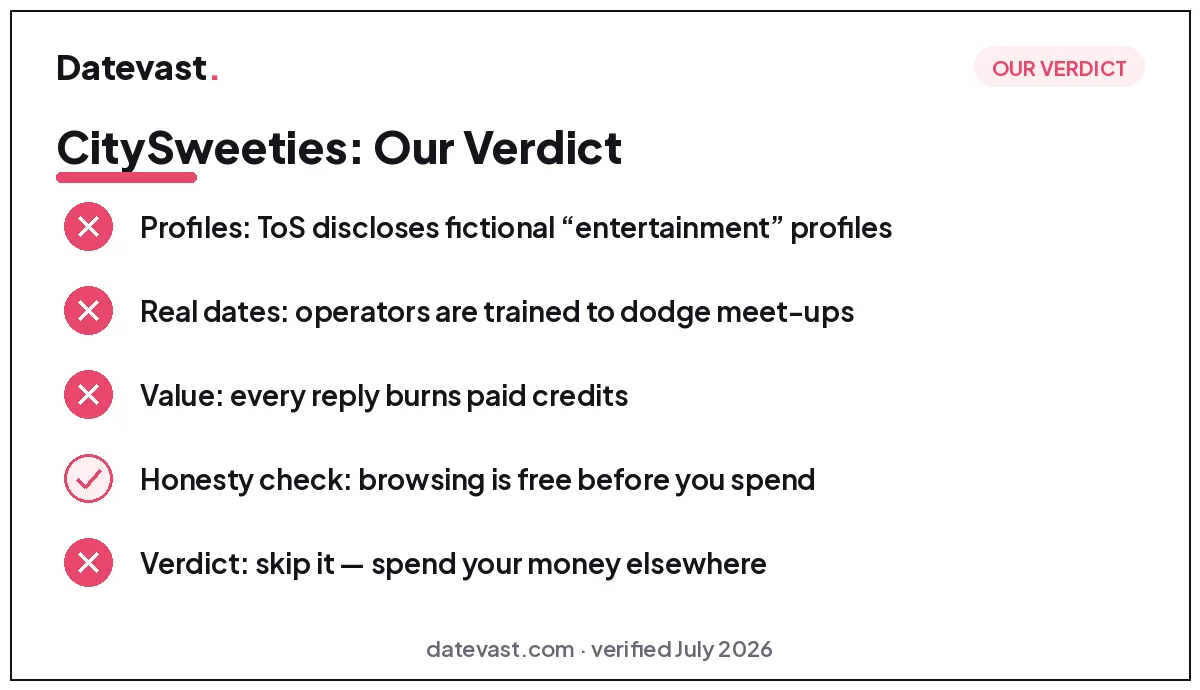
Skip it. Not because the website is broken or your card details are in danger — but because the product being sold isn’t the product on the label. Your money buys conversation with paid personas, and the company itself says meet-ups aren’t possible.
If you want actual dates, put the same money toward a mainstream app where the profiles are real people — imperfect as they are. Start with our honest reviews of Tinder, Bumble, and Hinge — each covers costs, fake-profile risks, and who the app suits best.
FAQ: CitySweeties
Is CitySweeties a real dating site or just entertainment?
By its operator’s own framing, it’s entertainment. The terms reportedly disclose fictional operator-run profiles, and the company told the BBC that meet-ups are “not possible.” The homepage sells it like dating; the fine print sells it like fantasy chat. Believe the fine print.
Are the profiles on CitySweeties fake?
A substantial share are “entertainer” profiles run by paid chat operators, per the site’s own reported terms and reviews of the platform. There’s no identity verification, so even the remaining profiles come with zero guarantees.
How much does it cost to message someone on CitySweeties?
About $1–$1.50 per message depending on the credit bundle, per recent reviews — packages reportedly run from around $50 for 25 messages up to $300 for 300. Browsing is free; every reply you send costs a credit.
Can you actually meet anyone from CitySweeties in person?
The operator itself told the BBC that meet-ups are not possible on this type of profile. Chat operators are trained to deflect meet-up requests indefinitely. Plan for the answer to be no.
How do I get my money back from CitySweeties?
Credits are pre-paid and effectively non-refundable through the site. Your realistic options: dispute the charge with your card issuer (chargeback), and report the experience to the FTC at reportfraud.ftc.gov or your local consumer-protection authority. Then close the account and unsubscribe from its emails.
Also see: our Provocative Neighbors review — the same network’s sister site, same verdict — our FartPartners review — a different flavor of the same pay-to-chat network model — and our dating app directory for options with real user pools.
Was this guide helpful?
Something wrong or missing? Tell us — we read every report and fix issues fast.
Thanks for your feedback!