Quick answer: Left Field was the buzzy “no swiping” dating app that landed a Shark Tank deal with Kendra Scott and Alexis Ohanian in January 2026 — and as of July 2026, it appears to be gone. The app is no longer on the App Store (we checked), its website is offline, and one Shark Tank tracker reports the company said it’s “taking a break” and deleting user data. Here’s what it was, what happened, and what to try instead.
What Was Left Field?
Left Field was a New York–born dating app built around one big idea: no swiping, no browsing, no endless deck of strangers. Instead, you turned it on, closed it, and lived your life — and the app quietly noticed when you crossed paths in real life with someone it thought you’d click with. Tech press kept calling it the “Pokémon Go approach to romance,” which is honestly a pretty fair description.
It was founded by Kate Sieler and Samantha Martin, two women who built it out of sheer burnout with the NYC dating scene. They launched early access in February 2025, opened up New York City that March, and grew it the scrappy way — partnering with local bars, comedy venues, and run clubs instead of buying ads. By the time they filmed Shark Tank, the founders said the app had about 5,000 users who opened it roughly eight times a day (their own figures, so take them as the pitch numbers they were).
How Left Field Worked (No Swiping, Really)
The mechanic was genuinely different from anything the big apps do:
- Cross-paths matching. The app watched for real-life overlap — you and another user frequenting the same coffee shop, the same gym, the same block — and treated that as the starting point for a match.
- “Social overlap” AI. On top of location, it looked for shared context: mutual friends, hometowns, neighborhoods, college towns, overlapping routines and interests. The founders’ pitch was that every match should feel “like a setup from a friend,” not a cold intro to a stranger.
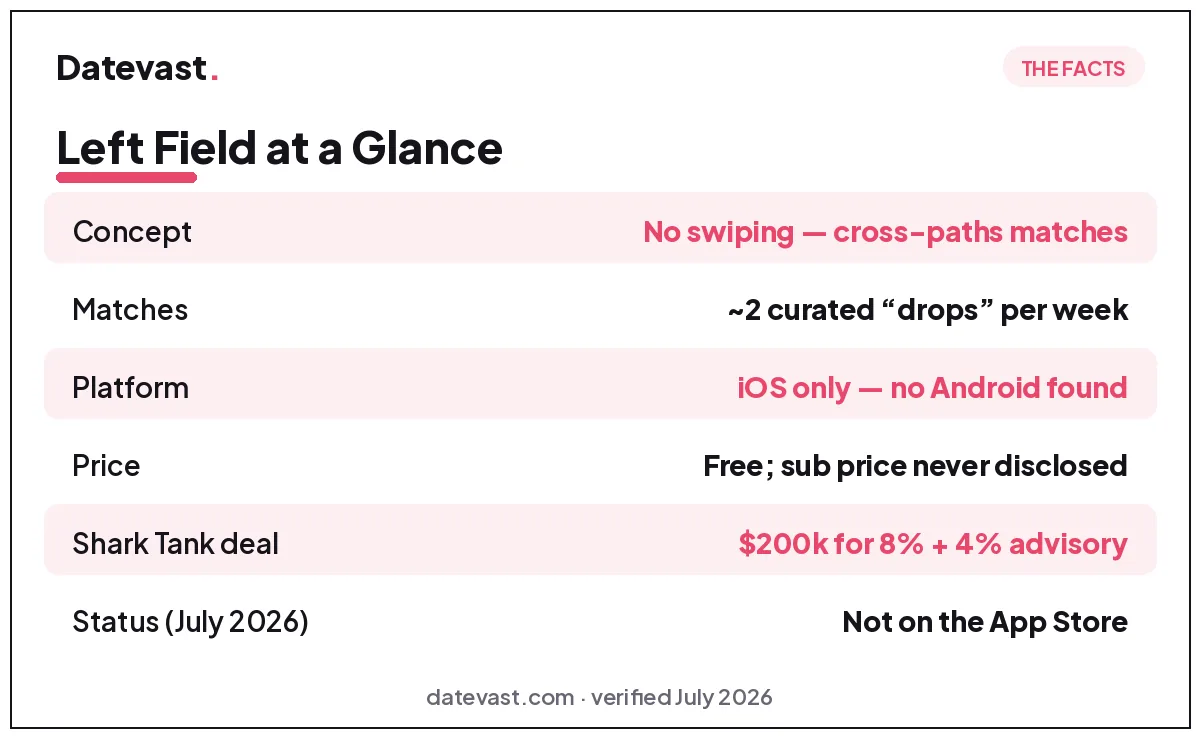
- Curated “drops,” not a feed. Instead of unlimited profiles, you got roughly two curated matches a week, each with a personal note explaining why the app put you two together.
- Privacy guardrails. Location was shared at the neighborhood level only — no exact pins, no live tracking trail. You could toggle location off any time.
It was iOS-only — we found no evidence an Android version ever shipped — and the core app was free, with plans for a paid subscription aimed at men (the founders noted most paying dating-app customers are men). The actual price of that subscription was never publicly disclosed.
The Shark Tank Deal
This is the part that put “left field dating app” into everyone’s search bar. Sieler and Martin appeared on Shark Tank season 17 (aired January 21, 2026) asking for $200,000 for 5% of the company — a $4 million valuation.
They left with an on-air deal from two guest sharks: $200,000 for 8% equity plus 4% in advisory shares, split between Kendra Scott (the jewelry founder) and Alexis Ohanian (Reddit co-founder and a very loud believer in founder-led consumer apps). Searches for the app reportedly jumped about 75% overnight, and the download spike briefly made Left Field the most talked-about dating app in the country.
One honest footnote: an on-air handshake isn’t a closed deal — Shark Tank agreements go through due diligence afterward, and plenty quietly change or fall through. Neither side has publicly confirmed how this one ended up.
Is Left Field Still Available?
Not right now — and this is the part most articles haven’t caught up with. Here’s exactly what we found when we checked in July 2026:
- It’s not on the App Store. The developer account (“Left Field”) still exists, but it has zero apps attached — the listing has been removed. Searching the US App Store for the app returns nothing.
- The website is offline. The app’s domain no longer resolves at all.
- A wind-down notice was reported. One Shark Tank company tracker reports the site posted a message saying the platform is “taking a break” and permanently deleting user data. We couldn’t verify that message first-hand (the site was already gone), so treat the wording as reported rather than confirmed.
Nobody involved has published an official shutdown announcement, which leaves a sliver of “maybe it’s a relaunch pause” hope — new investors sometimes do force a rebuild. But if you’re deciding whether to wait around: an app with no App Store listing, no website, and a reported data-deletion notice is not an app you can date on today. If it comes back, we’ll update this review.
Was Left Field Legit — and Was It Safe?
Legit? Yes — this was a real, venture-backed app with named founders, real press, and a national TV deal. It was never a scam. The interesting debate was always about safety, and it split people right down the middle:
The case for: the founders argued Left Field was “safer by design.” Location was fuzzed to the neighborhood level with no exact pins or tracking trails, and matching through mutual friends and shared social context meant the person you met was rarely a total stranger — mutuals create accountability.
The case against: critics found the whole premise uncomfortable — a dating app whose core feature is knowing you crossed paths with someone. One widely shared reaction put it bluntly: “this is pretty dangerous — you will need more safety measures than that.” There was also a practical worry: if a cross-paths match went badly, that person, by definition, hangs out where you hang out.
Both sides had a point, honestly. The neighborhood-level design was more privacy-careful than skeptics gave it credit for — and the skeptics were still right that proximity dating carries a risk swiping apps don’t. If the reported data deletion is accurate, it’s at least a responsible way to wind down.
What to Try Instead of Left Field
If Left Field’s pitch — less swiping, more real life — is what drew you in, a few living apps scratch the same itch:
- Breeze skips the endless chatting entirely and books you an actual first date at a partner bar. It’s the closest thing to Left Field’s “get off the app and meet” philosophy that you can download today — our Breeze review covers exactly how it works and what it costs in the US.
- Happn is the original crossed-paths app — it’s been matching people who pass each other on the street since 2014, and it’s still going.
- Hinge keeps the “designed to get you off the app” energy with a much bigger pool — see our Hinge review. And if you want the women-message-first model, our Bumble review has the honest rundown.
Our Verdict on Left Field
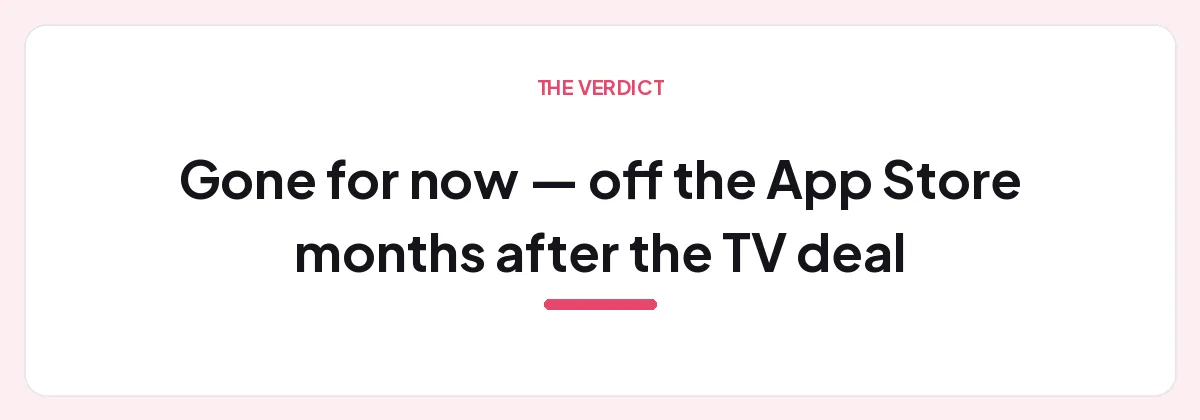
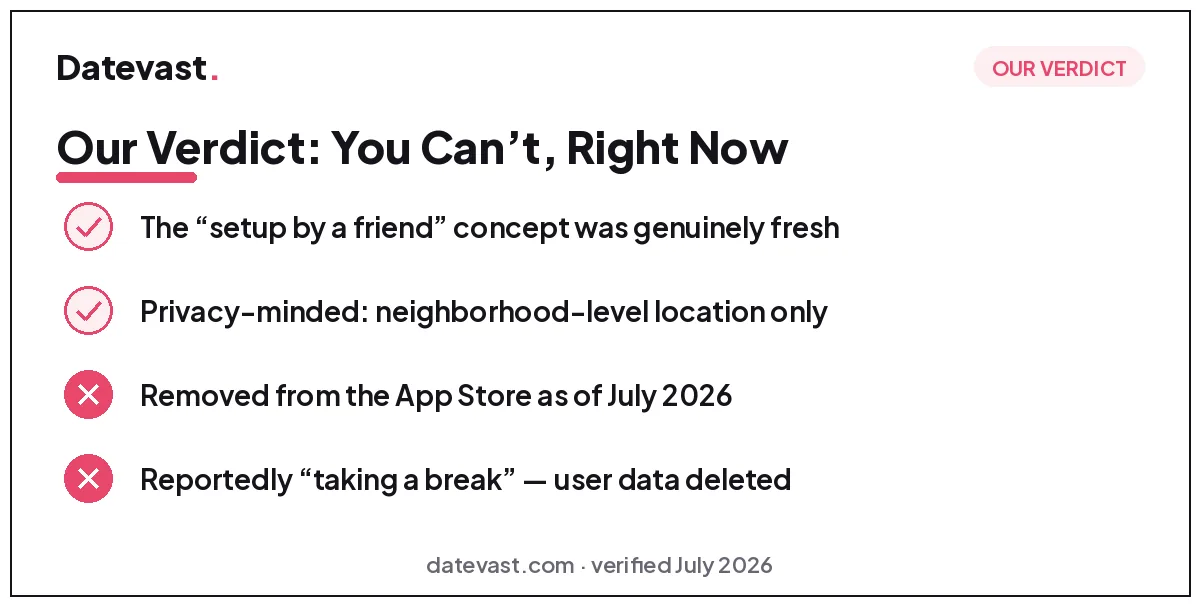
A genuinely fresh idea you can’t actually use right now. Left Field earned its hype — the no-swipe, matched-by-your-real-life concept was one of the most original things to happen to dating apps in years, and the privacy design was smarter than the hot takes suggested. But as of July 2026 the app is off the App Store, the site is dark, and the reported notice says user data is being deleted. Don’t wait around for it: try Breeze or Happn if the real-world concept appealed to you, and check back here — if Left Field relaunches, this review gets updated first.
FAQ: Left Field Dating App
Is Left Field still available to download?
No. As of July 2026 the app is not on the US App Store — the developer account exists but has no apps attached — and the website is offline. An Android version never existed as far as we can find, so there’s currently no way to download Left Field.
What happened to Left Field after Shark Tank?
It got an on-air deal ($200,000 for 8% plus 4% advisory shares from Kendra Scott and Alexis Ohanian) and a huge spike of attention after the January 2026 episode. Sometime in the months after, the app disappeared: one Shark Tank tracker reports the site said the platform was “taking a break” and permanently deleting user data. No official shutdown statement has been published.
How did Left Field work?
No swiping and no browsing. You kept the app in your pocket, and it matched you with people you actually crossed paths with in real life, layered with shared social context like mutual friends and hometowns. You got about two curated match “drops” a week, each with a note explaining why you were paired.
Who invested in Left Field on Shark Tank?
Guest sharks Kendra Scott and Alexis Ohanian, jointly: $200,000 for 8% equity plus 4% advisory shares, split between them. The founders had asked for $200,000 for 5%. As with any Shark Tank agreement, the on-air deal was subject to due diligence afterward.
Was Left Field free?
The core app was free. The founders planned a paid subscription aimed mostly at men, but its price was never publicly disclosed before the app went offline.
Is Left Field coming back?
Unknown. There’s been no official statement either way — just the reported “taking a break” notice and a removed App Store listing. If it relaunches, we’ll update this review with what changed.
Also see: our reviews of Breeze, Hinge, and Bumble — or the full dating app directory.